World Conference of Transport Research, Toulouse 2026 (WCTR 2026 Toulouse)
National and Regional Transport Planning and Policy
Chairperson: Özge Yalçıner Ercoşkun
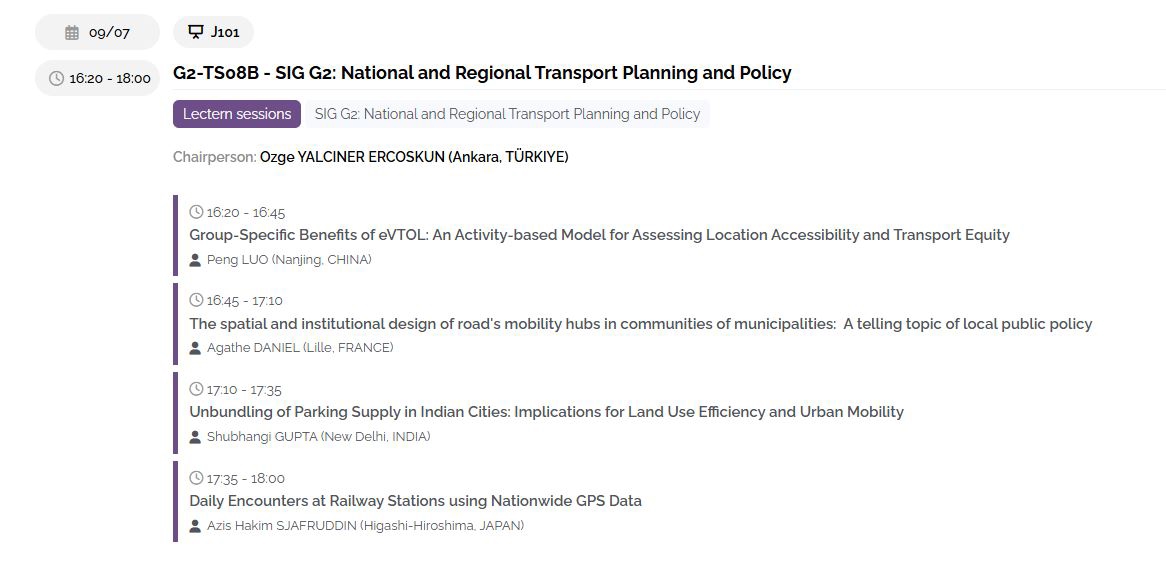
National and Regional Transport Planning and Policy
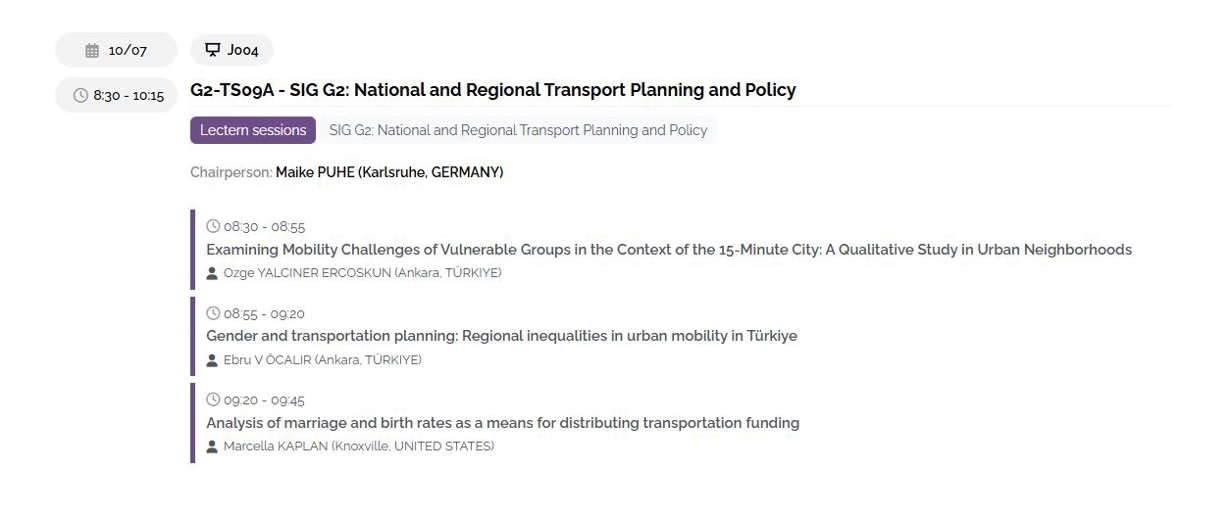
Examining mobility challenges of vulnerable groups in the context of the 15-minute City: A qualitative study in urban neighborhoods
Özge Yalçıner Ercoşkuna , Ebru Vesile Öcalıra, Ceren Ercoskuna, Hilal Tulan Işıldarb, Tuğçe Olgunc, Janina Welschd and Anna-Lena Stroms-van der Vlugtd
aFirst affiliation, Gazi University Faculty of Architecture Department of City and Regional Planning, Ankara, Türkiye
bSecond affiliation, Institute for Natural and Applied Sciences, City and Regional Planning, Ankara, Türkiye; Ministry of Transport and Infrastructure, Ankara, Türkiye
cThird affiliation, Gazi University, Institute for Natural and Applied Sciences, City and Regional Planning, Ankara, Türkiye
fFourth affiliation, ILS Research gGmbH, Dortmund, Germany
Abstract
The 15mC has gained prominence in urban studies, particularly after the COVID-19 pandemic. Beyond providing walking and cycling infrastructure, it emphasizes ensuring residents’ access to essential services and amenities within a 15-minute walk or bike ride. Central to this vision is not only spatial proximity but also the quality and inclusivity of everyday mobility, especially for vulnerable groups. This study examines how well existing built environments support these principles, focusing on older adults (65+) and parents with young children. Walk-Along Interviews were con-ducted in two municipalities of Ankara, Türkiye, where 18 participants shared real-time experiences while navigating their neighborhoods. Interviewers and observers accompanied them during routine trips, capturing perceptions of mobility challenges. The qualitative data were coded and analyzed in MaxQDA, with attention to categories such as access to services (shops, healthcare, public transport) and walkability (sidewalks, crossings, safety). Findings reveal that vulnerable individuals are highly sensitive to infrastructural and environmental barriers and often lack alternative travel options. Consequently, they report lower satisfaction with their journeys and stronger dependence on supportive urban design. These insights highlight the necessity of inclusive planning to ensure that the 15mC achieves its promise of equitable and sustainable accessibility.
WCTR 2026, Toulouse